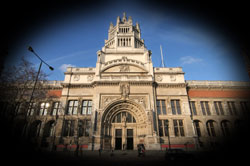
















The Gilbert Collection - A Gift to the Nation


INDEX


Historic Somerset House - Home of London's Newest Museum

In Millennium year London will be the richer for the opening of a new museum in one of the country's most important buildings, Somerset House, which has been described as "the greatest English public building since Greenwich" (Sir John Summerson: Architecture in Britain 1530-1830). Major restoration and renovations are currently being carried out and the South and Embankment Buildings will become the permanent home of the spectacular Gilbert Collection of decorative arts. This is one of the most important collections of works of art ever given to Britain.

History of Somerset House

Somerset House from the River ThamesSomerset House was built as government offices in the last quarter of the 18th century by Sir William Chambers, architect to George III. The site on the River Thames was originally occupied by episcopal houses, developed in the late 1540s to create a Renaissance palace for the Lord Protector Somerset. When Somerset was executed in 1552 his palace was seized by the Crown and served as a royal dower house in the 17th and 18th centuries. During this time important work was carried out on the building by some of England's greatest architects including Inigo Jones, John Vanbrugh and William Kent. The entire complex was then demolished to make way for the magnificent building we see today which was constructed from 1776 onwards.

The present Somerset House is remarkable as one of the earliest purpose-designed government office buildings in the world, with some 50,000 square meters of accommodation on five storeys arranged around a courtyard measuring 106 by 94 meters. The Courtyard is one of the most distinguished urban spaces in London but until recently was used as a civil service car park. The building of Somerset House was a feat of civil engineering requiring both the construction of the Embankment Building in the Thames itself, which contained the King's Barge House, and the terracing of the rest of the site to provide the finished ground level of the Courtyard. The Embankment, as we know it today, was constructed some 80 years later, cutting the Embankment Building off from the river. From the time of its construction, the offices were coupled with accommodation for learned societies and exhibition space: the Royal Academy of Arts and the Society of Antiquaries were both based there until moving to Burlington House in the middle of the 19th century.

Sir William Chambers, the architect of this neo-classical masterpiece, was a founder and treasurer of the Royal Academy of Arts and the building exemplifies the theories he set out in his Treatise on Civil Architecture published in 1759. The west side of the building is bounded by the approach to Waterloo Bridge. The principal entrance is through a tripartite gateway from the Strand. The south side of the Courtyard gives access to the Seamen's Waiting Hall and the Embankment Building beyond. A forecourt off the approach to Waterloo Bridge gives more direct access to the New Wing while the Embankment Building is entered through the original Watergate on the Victoria Embankment. The Great Arch that allowed the river to flow into the dock of the King's Barge House was closed in when the Victoria Embankment was constructed in the 1860s but has been excavated to its footings thus restoring its full height and reinstating the 18th-century richness and Piranesian drama of the South Building. In addition an 18th-century navy commissioners' barge, originally kept in the King's Barge House, will be on display.

Present and proposed uses

Somerset House from the StrandThat Somerset House has survived remarkably intact for more than 200 years is largely due to the fact that it has continued to be used for the purpose that was originally intended. The Fine Rooms and the Exhibition Room of the Royal Academy in the North Wing facing the Strand are now used by the Courtauld Institute of Art and King's College occupies the East Street in a fine building by Sir Robert Smirke. Today the Inland Revenue maintains the tradition of government offices in the East and West Wings.

Her Majesty's Stationery Office vacated the western half of the Embankment Building early in 1996 and the Lord Chancellor's Department moved out in 1998 leaving the eastern half and the South Building ready for the construction of the new galleries that will house the Gilbert Collection. It is envisaged that the upper floors of the South Building will provide additional exhibition space, restaurants and visitors' facilities, thus opening up this great building with its fine views over the Thames to the general public.

Gilbert Collection

Somerset House is eminently suited to house the important collections of gold, silver gold boxes and mosaics formed by Sir Arthur Gilbert and the adaptation of this historic building will enhance its cultural significance. The detailed proposals for the galleries formed part of a plan for the whole of Somerset House prepared by Peter Inskip + Peter Jenkins Architects. The building is listed Grade I and listed building consent and planning permission were granted by Westminster City Council in late 1997, after full discussions with English Heritage.

The principal entrance to the Gilbert Collection will be from Victoria Embankment through the original Great Arch at the centre of Chambers' composition. The importance of this entrance and the 120-meter-long frontage of the museum will give the collection considerable presence as well as restoring Somerset House's status as the most important building on the Thames between the Palace of Westminster and the Tower of London.

The Gilbert Collection will be displayed in two distinct groups of galleries in the South Building and the Embankment Building. The groin vaulted Embankment Building galleries are arranged to either side of the entrance area within the Great Arch and on the newly constructed mezzanine floor. This runs two-thirds of the entire length of the building and reveals two bays of impressive double-height space at each end. The rooms in the South Building are of a quite different character, consisting of a series of simple spaces retaining Chambers' restrained classical details befitting the rooms of senior naval officers and high-ranking civil servants.

The different kinds of media in the collection have been set out in the separate suites of galleries. The Florentine pietre dure collection is displayed on the lower level of the Embankment Building, just after the entrance to the museum, while a separate double-height room at the east end of this building is devoted to the magnificent silver gates made for an Orthodox monastery in Kiev and presented to the church by Catherine the Great in 1784. The mezzanine floor is devoted to the display of the silver collection, with large island vitrines and further vitrines and display panels arranged along the walls. This display comprises a comprehensive body of English and Continental works from the 16th to the 19th centuries, which continues at the lower level towards the exit from the museum with spectacular groups of Indian silver furniture and concludes with the treasury or Schatzkammer. The latter is an accumulation of works of art in silver and silver gilt, many incorporating rare and precious natural materials such as rock crystal, oriental porcelain and exotic seashells. The suites of rooms in the South Building house the remaining elements of the collection. The large central space beneath the Seamen's Waiting Hall contains the spectacular gold boxes, innovatively displayed in small groups on individually fabricated mounts, which allow most of the boxes to be seen from all sides. The rooms to either side of this gallery are devoted to thematic displays of Roman micromosaics, enamelled portrait miniatures and other objects of solid gold.

Somerset House at night with floodlit fountainsAlthough the architectural treatment of the galleries allows the three collections to be displayed chronologically and thematically, the sequence of the spaces and the proximity of the collections will allow the visitor to appreciate the important interrelationship of many of the works of art, such as gold boxes inset with micromosaics. The display cases will be specially designed to show the exquisite details of the exhibits to their maximum effect, enhanced by the latest fibre optic lighting technology. The most modern technology will be used throughout the galleries not only for the lighting but also for security and ventilation as well as pollution, noise, temperature and humidity control. A new sub basement has been excavated for the service rooms and during the excavations the foundations and lower courses of the original Tudor river wall were discovered. These were shown retaining the parterres of old Somerset House in Canaletto's celebrated view of 1750. These discoveries necessitated the diversion of some service routes to avoid disturbing the important archaeological finds. The mid-basement floor of the South Building will also provide offices, security rooms, stores, cloakrooms and there will be a Gilbert Collection shop next to the Great Arch entrance. Disabled access will be available to all parts of the building.

The Gilbert Collection project team is: The Heather Trust for the Arts (Guardians of the Gilbert Collection), Davis Langdon Management (Project Managers), Heery International Ltd (Construction Managers), Peter Inskip + Peter Jenkins Architects, Davis Langdon Everest (Quantity Surveyors) and Oscar Faber (Structural Engineers). The Museum Designer is 3D Concepts in consultation with Dyson Design.

Sir Arthur Gilbert's munificent gift to the nation was an important catalyst to the opening up of Somerset House to the public. In 1914 Professor Albert Richardson pointed out that the building was "too good to be a store for buff envelopes" and 80 years later the removal of the Inland Revenue's printing works from the great vaulted spaces in the Embankment Building was the first step in allowing a major cultural centre to be established within this architectural masterpiece. It is a truly appropriate setting for the Gilbert treasures that will be unveiled in the Millennium year.


This information was kindly supplied by:

Sue Bond Public Relations,
Hollow Lane Farmhouse, Hollow Lane,
Thurston, Bury St Edmunds, Suffolk, IP31 3RQ

Tel. 01359 271085
Fax 01359 271934

Email: info@suebond.co.uk
www.suebond.co.uk

We are very grateful for her help in putting together this article about these amazing treasures.


All content is copyright of © Mosaic Matters and its contributors.
All rights reserved

Mosaic Matters is:
Editor: Paul Bentley
Web Manager/Designer: Andy Mitchell