HOW THE ALEXANDER MOSAIC WAS USED
By Rossella Lorenzi
Fri Jan 8, 2010
www.news.discovery.com
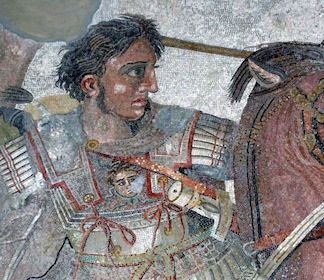 Wear
patterns on one of the most celebrated mosaics of antiquity have
allowed researchers to reconstruct exactly how ancient Romans viewed
the artwork. Wear
patterns on one of the most celebrated mosaics of antiquity have
allowed researchers to reconstruct exactly how ancient Romans viewed
the artwork.
Found during the 1831 excavations in the lava-buried
town of Pompeii, the Alexander mosaic (now on display at the National
Archaeological Museum in Naples) is the most famous example of an
early tessellated mosaic. Measuring 19 feet by 10 feet, the piece
was made around 100 B.C. out of roughly 4 million tesserae (small
mosaic tiles).
The artwork once decorated the floor of a room in the House of the
Faun, one of Pompeii's grandest residences.
The tiny tesserae, applied following the "opus
vermiculatum" technique (basically set in worm-like rows),
depicted a dramatic scene from a battle between Alexander the Great
and the Persian king Darius III.
"Although there is some disagreement as to
exactly which battle the mosaic depicts [either the Battle of Issus
in 333 B.C. or the Battle of Gaugamela in 331 B.C.], we know many
things about this mosaic. For example, it is uniformly agreed [that
the mosaic is] a copy of a famous Hellenistic painting executed
sometime around 300 B.C.," Martin Beckmann, of the University
of Western Ontario, Canada, told Discovery News.
"What is less know is the mosaic's role as
a floor surface in an Italian house. In this role, it has the potential
to provide evidence of the tastes, interests and desires of the
wealthy Romans during the late Republic," Beckmann said.
In his study, presented today in Anaheim, Calif.,
at the annual meeting of the Archaeological Institute of America,
Beckman looked at some large, entirely destroyed areas of the mosaic.
These areas were filled in ancient times with mortar and have been
in the same condition since they were originally discovered.
Beckmann identified four mains pattern of wear:
a large, crescent-shaped area around the portrait of Alexander,
two patches in the upper portion of the mosaic and two other patches
in the lower portion.
"The patches basically show us the mosaic
through the Romans eyes, and tell us what interested the ancient
viewer. Although Darius is the most prominent figure in the mosaic,
the Romans were much more interested in Alexander," he said.
"They were also apparently fascinated by the
plight of two Persians crushed beneath Darius' chariot, especially
one who is shown with his face turned from the viewer but reflected
in a shield -- a skillful artistic trick," he added.
"There is clear evidence of multiple ancient
repairs in these damaged areas. The most recent restorations filled
the gaps with mortar, while more ancient repairs used tesserae,"
Beckmann said.
According to Beckmann, the repairs tell a story.
They indicate that the mosaic had been damaged by overuse, and often
in exactly the same areas.
"Over time, even careful footsteps would have
loosened the very small stone tesserae from their tenuous hold in
the mortar of the mosaic's bedding. At least once, substantial repairs
were attempted, but clearly by the first century A.D., these had
been given up in favor of simple patching with plain mortar,"
Beckmann said.
The two upper patches of wear even allowed Beckmann
to reconstruct a theoretical "tour" of the mosaic. Here
is Beckmann's explanation:
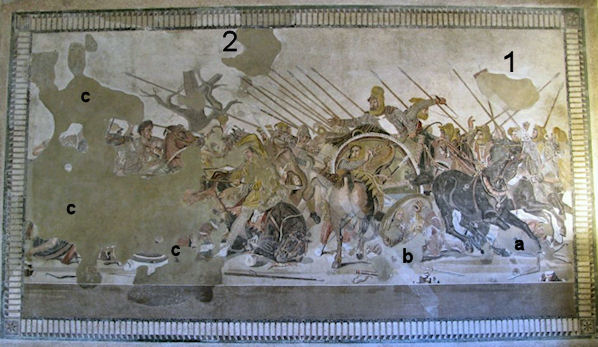
Once the visitors had entered the room --
we might imagine a group of dinner-guests led by their host -- the
tour would begin with Darius and his Persians.
The host would have stood above Darius' horses
(1), explained why the great king was fleeing, and pointed out the
artistic novelties in the lower portion of the mosaic.
The guests would have milled about
at the foot of the mosaic, taking in the overall scene, and then
briefly concentrated themselves around the figures of the two doomed
Persians (a - b).
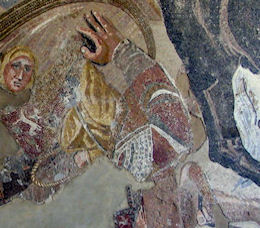
a) A Persian soldier is about to be crushed beneath Darius'
chariot. The Romans were particularly
interested in the reflection of the Persian's face in the polished
shield, a skillful artistic device employed to highlight the pathos
of the scene.
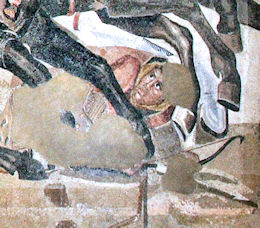
b) The Romans were interested in the figure of the unfortunate
Persian who crouches below the horses, surely about to perish beneath
their hooves. Presumably the extreme nature of his plight attracted
their attention.
Then the host moved to the left and stationed himself
in the area above the figure pair composed of Alexander and the
unfortunate Persian he is spearing (2).
The guests marched right onto the mosaic and crowded
around the image of the Macedonian king, standing right on top of
his body (c ), being careful however not to step on his head or
that of his horse.
The guests arranged themselves in a semicircle,
so as to leave a line of sight open between them and their host,
who was also able to see Alexander's head from his vantage point
above.
Here the guests stayed the longest and here is
where the ancient tour would end.
Photos: courtesy of Martin Beckmann.
|